Products 2026
Mosaic
A private photo and video library that updates as people upload.
Mosaic is a private place for photos and videos. It is multi-user, passwordless, and invite-only by default: someone with the Inviter role sends a one-time link, and the new member lands in a library that already has everyone else’s media in it.
Invite first
Access is role-based. An account can hold Viewer, Uploader, Editor, Curator, Inviter, and User manager roles; an admin holds all of them. An admin can turn on “Request access” so people can ask to join instead of waiting for an invite, and can set per-user limits on file size and total storage.
The default is shared: every photo, video, and album is visible to everyone with an account. “Only me” is the exception, and groups are how the exception scales.
Upload, then organise
Uploads are drag-and-drop and can carry many files at once, with a progress panel that stays out of the way. A batch uploaded together becomes one album automatically, with an optional name typed on the Upload page; name, tag, and organise it afterward. Duplicate detection stops the same file from arriving twice.
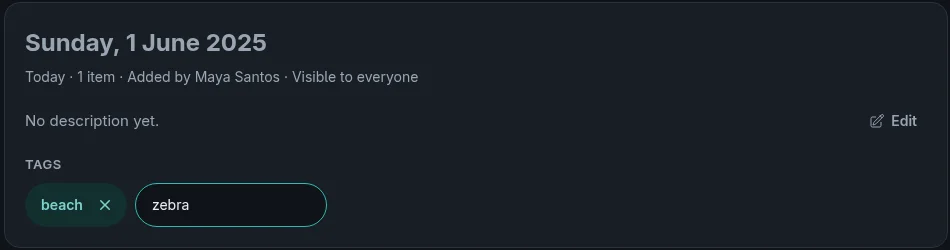
The timeline is the front door: every photo and video by date, updating live as uploads land. The calendar, jump-to-day, and date scrubber cover the cases where scrolling is the wrong tool. Tags, captions, and rich-text comments (built on Quillon) sit on top; albums download as a zip and play as a slideshow.
Who can see what
Visibility is explicit on every item. The Everyone group is the default, personal groups are for narrower sharing, and “Only me” is for the photo that should not leave the uploader’s account. The same rules apply to albums and to the files inside them.
The machinery
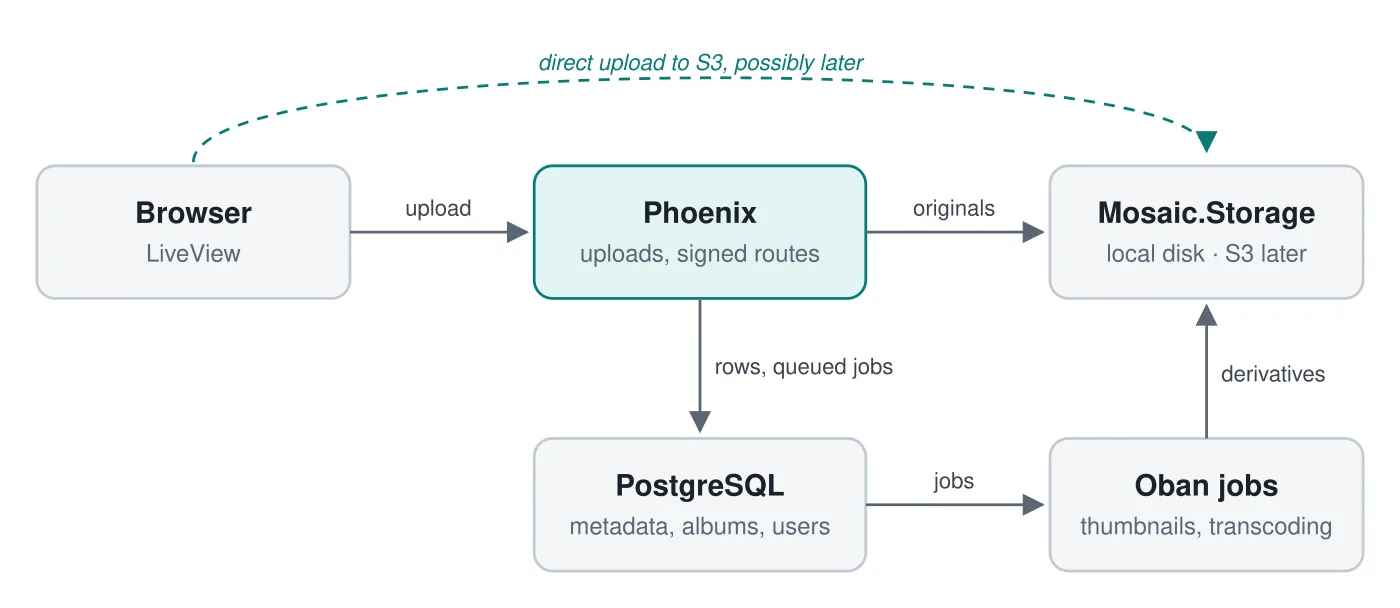
Mosaic is a Phoenix LiveView application. PostgreSQL holds metadata, albums, users, and queued jobs. Oban runs the heavy work: thumbnails and video transcoding through libvips and ffmpeg, with face detection and grouping on worker machines when the queue calls for it. Storage sits behind an adapter: the local filesystem first, then S3 or any S3-compatible service.
Smaller pieces of the stack are libraries from this site: StaticMaps renders map images for photo locations, and GnuplotEx draws the admin charts. Face embeddings live in PostgreSQL with pgvector.
Status
Mosaic is in development. Albums, tags, comments, people, slideshows, downloads, invites, and the admin area exist in the running application; the remaining work is storage backends and the heavier background pipelines.